By Bill Barth and Stephanie Klett
History and tradition are best learned by living it.
At Old World Wisconsin that’s a business plan, where preserving and passing on the immigrant pioneer experience has been the mission for 50 years.
We visited the 600-acre site, located just off Hwy. 67 in Eagle, to talk with the team about its 50th anniversary year.
Tip: Road construction in the area is a minor inconvenience and can be a bit confusing. Be patient. You’ll get there. Besides, the trip is well worth the drive even before arriving at the destination. Eagle is located in the beautiful Kettle Moraine region. The countryside is visually stunning, especially if you are daring enough to meander along lesser-traveled rural roads.
What you will find upon arriving is a fascinating living history attraction, containing about 60 period structures moved from sites across Wisconsin. There are stone structures that were completely broken down, transported and reassembled. Others were separated into two or three pieces, moved and restored. The oldest is St. Peter’s Church, originally built in 1839 in Milwaukee, restored to its 1880s appearance. The oldest interpreted structure is the 1840s settler’s cabin, brought to Old World Wisconsin from Newark township in Rock County.
Historic buildings have been relocated from as far away as the Mississippi River to the west and Bayfield County on Lake Superior to the north.
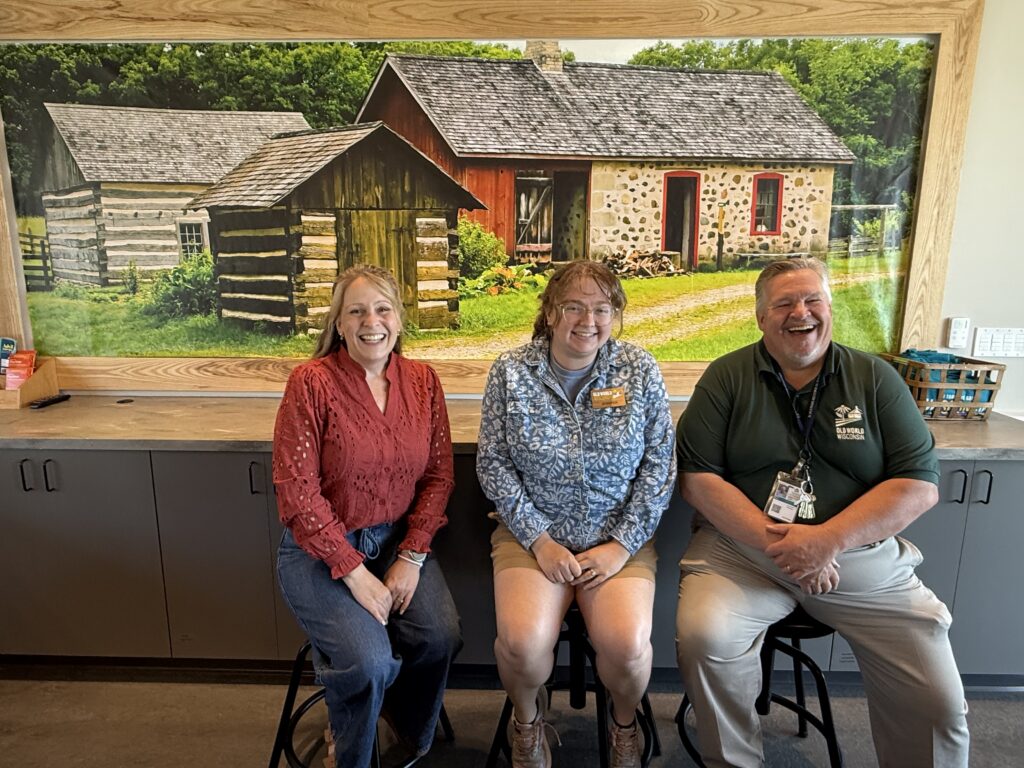
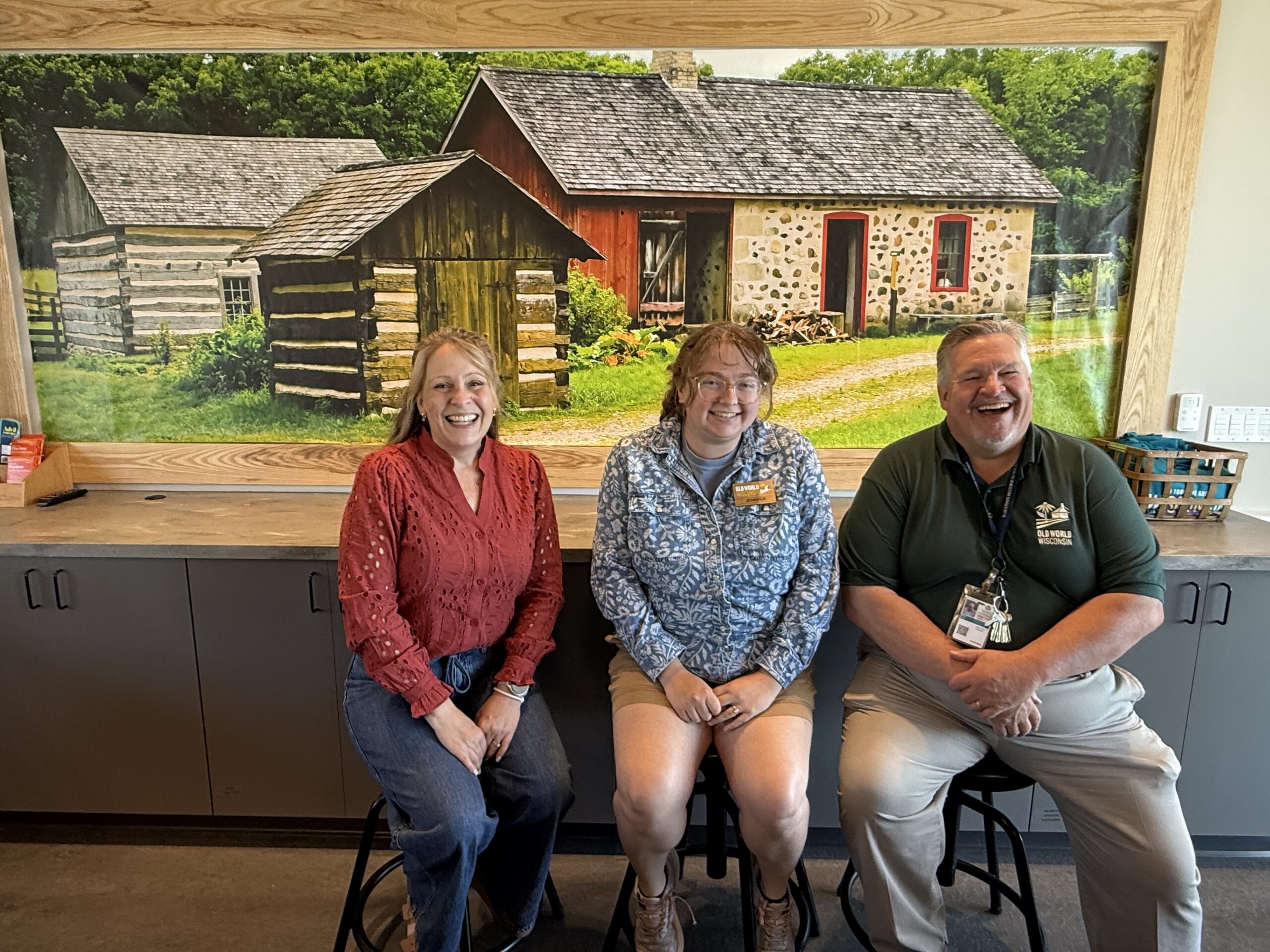
We were greeted by four key members of the Old World Wisconsin team, Doug Raney, director; Betsy Gasper, general manager of guest services; Jennifer Melka, collections and exhibits coordinator; and Dan Hess, general manager of experiences and events. Their excitement and enthusiasm for the work of preserving history is genuine and runs deep.
Jennifer, who has been with Old World Wisconsin for a decade, exudes appreciation for the museum’s composition.
“I would say 95% of the structures you will see on-site are actual historic structures, they were just not here. They moved here from all over the state,” she told us. “Every building on-site was given a restoration period, so whatever period made the most sense for that specific structure, what story we wanted to tell, it was restored to that time period.
“Some of the reasons why these buildings were picked is their unique architecture styles from the different ethnic groups across the state of Wisconsin,” Jennifer said. “If you came to Wisconsin you’re going to build the way you built where you came from, if you’re an immigrant.”
Dan is the man when it comes to guest experiences. We asked him what visitors can expect as they roam the grounds and interact with staff members dressed in period garb.
“We call them experience facilitators,” he said. “We have people in period clothing. We’re trying to show what kind of clothing these people would have been wearing at these times. We do third-person interpretation, so they’re not necessarily in character, but they’re out on the site and talking about the period they are interpreting.”
Person-to-person contact is the foundation of the experience.
“We want our guests to get as hands-on as possible. You really get the best experience when you get to try it yourself. That could be harvesting crops in the field, cooking over a woodstove, that could be helping with spinning, or helping turn the blower in the blacksmith shop,” Dan told us.
Old World Wisconsin opens in the spring, when visits by school children are frequent. The summer season through August is the busiest. Fall weekends are also popular. There are special events at other times of the year, but off-season is largely used to maintain historic attractions, complete planning and budgeting and, of course, take care of the heritage animals – oxen, horses, pigs, chickens, sheep, a 365-days a year job.
The team stresses that visitors should allow enough time.
“It is a large site,” Betsy said. “If you want to see everything, go into the buildings, interact with our interpreters and get what we would consider the full experience, it’s four to five hours.”
Doug explained that the living history museum attracts about 75,000 visitors annually, and the goal is to reach 100,000.
The museum opened during the 1976 bicentennial year, and for its 50th anniversary – and America’s 250th – the site will dedicate its beautiful new Welcome Center.
To purchase tickets or find more information go to the website (oldworldwisconsin.org).
Old World Wisconsin is associated with the Wisconsin Historical Society, which operates 12 historic sites around the state including Black Point Estate in Lake Geneva and Circus World in Baraboo. Patrons can purchase memberships that allow admission to all statewide attractions.
The team is particularly proud of food and beverage options on the grounds, often featuring historic recipes. The 50th celebration includes a special heritage beer, Betsy told us, based on the 1948 Schlitz recipe.
“It’s a very limited release. We’re doing a collector’s can with Old World Gold on it,” she said. “We’re excited to have the 1948 Schlitz recipe in those cans because our Wittnebel’s Tavern is from the time period of the ‘30s and ‘40s.”
We’ve both visited Old World Wisconsin before, but the sheer size and scope of the place mean there’s always something new to experience.
Help celebrate 50 years of living history.
Bill Barth is the former Editor of the Beloit Daily News, and a member of the Wisconsin Newspaper Hall of Fame. His wife, Stephanie Klett, is the President and CEO of Visit Lake Geneva, and the former Secretary of the Wisconsin Department of Tourism.