
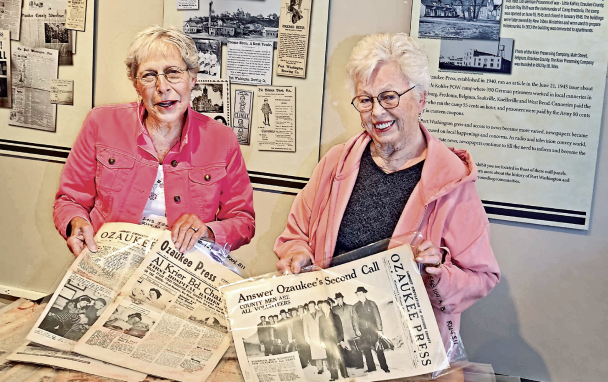
A new Port Washington Historical Society exhibit chronicles the history of the community’s publications, from the time they were numerous to today when just one remains.
A piece about the exhibit appeared in the May 13, 2026 issue of The Ozaukee Press. According to the story:
For the past two years, volunteers at the Port Washington Historical Society have been combing through grocery bag after grocery bag of old newspapers at the Resource Center in downtown Port.
“We would sit upstairs and chuckle at some of the stuff they were imparting to the community,” Collections Manager Jackie Oleson said.
In addition to major news events, some of the early papers had stories on how to store butter, she said, while others talked about how to deal with chickens that had lice. During the early days of the Spanish flu pandemic in the early 1900s, there was advice on how to ward off the disease.
“There were a lot of how-tos,” Oleson said.
“A lot of down-home stuff,” Geri Zehren, the center’s business manager, said.
Today, the newspapers are at the center of a new exhibit at the Resource Center, “Extra! Extra! Special Edition: The newspapers of Port Washington,” which will run through next spring.
Realizing that a pile of newspapers isn’t necessarily an attraction for everyone, the exhibit organizers paired copies of the papers with items from the society’s collection that are advertised in them, such as a pair of showy shoes from Allen Edmonds Shoe Corp. and bottles that once held a variety of libations.
One of the most astonishing things is the number of newspapers that once called Port Washington home, Oleson said. There was the Washington County Democrat in 1847, just a few years after the city was founded — Port was then a part of Washington County — The Washington County Eagle, Port Washington Republican and more. More well known are the Port Washington Zeitung, the Port Washington Herald — previously known as the Harold — The Star, Port Pilot, and the only paper remaining today, Ozaukee Press.
In 1898, Oleson noted, the city had a population of 3,400 people and four newspapers — the Zeitung, Herald, Star and Pilot.
“And we were just a small little town — we’re not Milwaukee,” Zehren said.
Some of the papers were affiliated with a political party, Oleson said. Some were written in German and many in English — the Herald started as a German paper but changed to English during World War I — and some lasted only a short time, perhaps six months. But they all had a basic mission, to tell people what they needed to know to enhance their daily lives.
“I think there was a really huge urge on the part of people to get information out,” she said. “They really felt it was important. They knew they weren’t going to get rich with this — some of these papers only lasted six months — they wanted to have a means to get news out to people.”
Early newspapers provided world news Oleson said, but after World War II they began to change.
“I think that’s when they went from a more global scale to local news,” she said. “That’s when our papers became local papers.”
While some people consider old newspapers as dusty, musty pieces of paper, they are so much more, Oleson said. “They give us the context of what things looked like back then, what people held close,” she said.
It’s also a lot of fun to check out the old advertisements, Zehren said, noting an electric range cost $99 in 1941.
These old papers can be addicting, Oleson added, noting that one volunteer got so absorbed in reading the stories in these early editions that they took forever to catalog.
While it’s not uncommon for the Historical Society to receive numerous copies of modern publications like Ozaukee Press, Zehren said among the “coolest things” the organization received in the last year were full copies of the first 22 issues off the Port Pilot, which began printing on Aug. 4, 1898.
The importance of newspapers can’t be overstated, Oleson said. “If we didn’t have local newspapers, who would be sitting at our community meetings, questioning things?” she asked. “They’re not beholden to government. They are our representatives.”